Hi everybody! It's been a while, but I'm back—or rather I'm in the same place I have been all semester, that is, Jordanville. As many of you may know, I'm in my fourth year. As some of you who have been seminarians in Jordanville may know, the fourth year is considered by some to be the year of искушение—temptation. It is said that this is the year in which seminarians have the most work to do, in which they feel the most emotional pressure, and in which they might even wish to leave the seminary, though they are so near the end of their student careers here. I have not been exempt from the infamous troubles which haunt those seminarians in my year.
The first of my искушение seemed harmless but ultimately could have made life very different for me now, and for you, as my readers. During the summer music school this year, I learned of a position in Chicago chanting at a certain parish. I was drawn to this opportunity to make some money to pay back my student loans (from when I attended the University of Hawaii), but ultimately I realized that I had better finish what I'd started here at the seminary before moving on to other, very different occupations in life.
Moreover, there are all the regular temptations to be found around the seminary: the urge to gorge oneself on meat, which develops after protracted periods of deprivation from such fare, the desire to sleep in past 5:30 in the morning (my snooze alarm and I have become well acquainted), and the wish to read through the prayers in the cathedral so fast, at times, that "Gospodi pomiluy" begins to sound like "GOS-pmph, GOS-pmph, GOS-pmph..." But these are the types of challenges that can easily be faced when a person takes the days one at a time, and tries to act sincerely in every part of a daily routine.
So though the fourth year is bound to present me with more challenges and its own unique brand of temptations, I am sure that with your prayers and with the help of my fellow seminarians here I will make it through—and I will be able to lay back and enjoy my senioritis next year in peace!
Ghostwritten by Sophia Urusova, girlfriend. :) Mwahahahaha!
After an interval of 15 months, I am finally back in my native land. I was sitting in the lawn of my family home, sheltered by the shade of the octopus tree, when I realized that I had not updated my blog since June. Of course, that needs to be rectified.
I spent most of my summer working part-time in the bookstore. I was in the bookstore for only about twenty hours a week, so I wanted to do something more with my time. I ended up helping Fr. Cyprian reorganize the many, many, MANY keys he has to hundreds of doors in the monastery and seminary. I also started to cook the monastery dinners on Tuesdays and Thursdays, a task which was mostly stress-free because dinner at Jordanville usually involves reheating lunch and maybe making a little bit more salad. I've been using my time in the kitchen to experiment with cooking. After all, one has few opportunities to have at one's fingertips a professional-grade kitchen (complete with a giant stick blender) and a group of diners who are willing to eat almost anything.
Meanwhile, I interacted with both the summer boys and the students of the Summer School of Liturgical Music. There were fewer summer boys this year so I hardly noticed them, but I saw the music people every day for the space of about two weeks since I was auditing typikon classes at the music school. I learned quite a bit about the order of divine services, including more about the Biblical Odes than most people need to know.
I also went to a couple of weddings. My friends Anthony and Bridget married each other in late July, a pleasant wedding with catered barbecue and country music. I got seated with some old Jville friends and had a great time. Three weeks later, I went to the wedding of my friends Alex and Juliana Cooley. But that deserves another blog post. In between the weddings I went to St. Vladimir's Memorial Church in Jackson, NJ for the 1025th anniversary of the Baptism of Rus. It was a business trip, just like the one we took last year, but we sold quite a bit more due to the increased number of people.
Last weekend's activities were packed like sardines. First I went to Boston for a meeting with my editor, an event very cleverly disguised as a date. It helped that my editor is also my girlfriend. I then took a bus to Albany for the Cooliana wedding, and went back to Jordanville Sunday night. On Monday morning, I went to Syracuse for my trip to Hawaii. I hope to write about my trip in the several weeks to come, since I plan to be doing more than just sitting around and eating pineapples all day.
I woke up on top of my bed in a bright room; I had fallen asleep without turning off the light. I fell unconscious again.
It was a little before six. Groggily I dragged myself out, got dressed, and walked out the door. Fr. Ephraim was standing in the lounge with the summer boys. "John, do you want to come with us to the woods for an English liturgy?" I figured, what the hey.
The Summer Youth Program is a great opportunity for young men to spend three weeks at Jordanville to get a taste of the quiet life of the monastery, do fun things and have spiritual discussions, and also do hard labor build character. It was a small group of five teenage boys. We piled into the big white van and drove up to the lakeside chapel, only to get stuck in the mud. We had to walk the rest of the way to the chapel.
It had been raining hard the past few days. Thankfully we're on high ground, but the people in Herkimer and Utica have had a tough time with flooding. It has gotten so bad that during the liturgy prayers are offered beseeching an end to the rain.
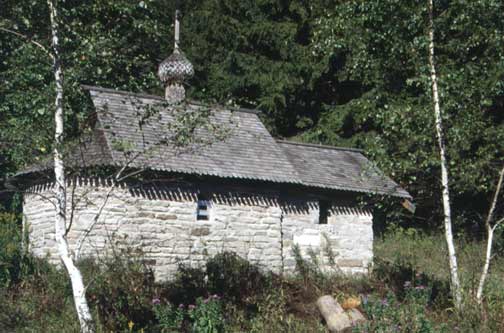
We walked about a third of a mile in the mud and wet grass, to the small stone chapel, with a grayish, weather-beaten wooden roof. A score of people filled the interior. Fr. Luke was serving at the tiny altar. The interior of the chapel is partially frescoed, with prominent icons of both St. John of Rila and St. John of Kronstadt, after whom the chapel is named. The singing was mostly in English, and was sung by some local women and a novice nun. The nun in question was dubbed "the coolest nun ever" by one of the boys because of the bright red galoshes she wore.
The English liturgies at the chapel are done on average once a week, but the schedule is erratic and is known only through word of mouth. But I highly recommend it, especially to English-speaking pilgrims.
After Pierre introduces Andrei and Natasha, they quickly fall in love and get engaged. However, Andrei’s strict father, Prince Nikolai, is suspicious of the union and makes Andrei wait a whole year until the wedding (they did things quicker in 19th century Russia). Andrei also made the engagement secret, so Natasha would be free to break it off without social repercussions. Andrei then went abroad to recuperate from his old war wounds.
Natasha, who was staying in Moscow with her family, then encounters Anatole, Pierre’s brother-in-law. Although Anatole got secretly hitched in a shotgun wedding to a Polish woman, he didn’t consider it an impediment and tried to seduce Natasha, convincing her to elope with him. Natasha fell in love with Andrei, but she fell in lust with Anatole. Pierre’s wife Hélène, knowing that Natasha was engaged, encouraged Anatole’s depravation, and the plan nearly succeeded until the very last minute when Anatole and his lackey were found out. The damage was already done: Natasha had already sent a letter to Andrei breaking off their engagement, and blinded by her feelings for Anatole became hostile to everyone. She finally became heartbroken when she found out that Anatole was married all along.
Pierre then comes into the picture. Before he left, Prince Andrei told Natasha to go to Pierre just in case anything was wrong, because “he’s absent-minded, but he has a heart of gold.” Pierre comforts Natasha, who thinks of herself as a ruined woman, despite not having yet done anything. Having lost both Andrei and Anatole, she feels unworthy of love. Pierre says differently. He declares to her: “If I were not myself, but the handsomest, cleverest, and best man in the world, and were free, I would this moment ask on my knees for your hand and your love!” From those words feelings awoke in Pierre which he did not realize before. Going home, he sees a comet in the sky—a portent of the coming chaos of 1812. The peace-loving Pierre was about to be enveloped in the horrors of war.Natasha, though relieved by Pierre’s words, still struggled through a long illness and depression. As for Pierre, he gradually fell in love with her, though because of his marriage did not act on his feelings. Nevertheless, he still thought things like: “Well, supposing N. N. swindled the country and the Tsar, and the country and the Tsar confer honors upon him, what does that matter? She smiled at me yesterday and asked me to come again, and I love her, and no one will ever know it.”
His love for Natasha, the coming war with Napoleon, and his Freemasonry all converge together in a rather humorous passage in which he works out the meaning of the number of the beast in the Book of Revelation. L’Empereur Napoleon, if the French alphabet had numerical values like the Hebrew, adds up to 666. Pierre calculates using various names, like L’Empereur Alexandre and La nation russe, before using his own name in various combinations, such as Comte Pierre Besouhoff, Le russe Besuhof and so forth, before finally fudging his own name (and French grammar) to get L’russe Besuhof, which also added up to 666 and made him feel like he, like Napoleon, was predestined for some kind of great act, which would “lift him out of that spellbound, petty sphere of Moscow habits in which he felt himself held captive and lead him to a great achievement and great happiness.”
This Pierre, in the summer of 1812, is very different from when we first encountered him in 1805. As a young man Pierre led a dissipated life in which he had no idea what to do in life and ended up being turned this way and that by the people around him. When he got married and went through the sufferings of a cheating wife and a brush with death, he got a little serious and committed himself to the causes of Freemasonry and philanthropy. Though he still leads a dissipated life, he has a burgeoning love for Natasha. He’s a little better than the beginning, in terms of being an active rather than a passive character. But he has to learn his last, painful lessons through the horrors of the war to come. In the summer of 1812, Napoleon invades Russia and “war began, an act opposed to human reason and to human nature.” The French take Smolensk (which ends up getting burnt down) and threaten Moscow, leading to the great battle of Borodino. Pierre visits the battlefield out of curiosity, but ends up getting caught up in the conflict. Before the battle, he meets up with his old friend, Prince Andrei, and has one last meeting, which both knew would be their last; Andrei is wounded in battle, and dies after a long struggle. When the battle begins, Pierre is at first observing, but soon begins to participate, starting with carrying ammo for the troops. His fancy hat and coat and his demeanor amuse the rank-and-file soldiers, but his persistence in the heat of battle win their admiration and respect for “the master,” as they call him at first mockingly, then endearingly.
Borodino soon turned into a slaughterhouse for both the Russians and the French. Pierre sees his new compatriots die violent deaths one by one. The French keep sending in troops and cannonballs, but the Russians hold their position despite the heavy bombardment. In the chaos he ends up in a desperate altercation with a French officer. “Am I taken prisoner or have I taken him prisoner?” both the Frenchman and Pierre thought to themselves as they gripped each other, the stalemate broken by a closely-fired cannonball. Pierre manages to escape, but not without becoming traumatized by what transpired that day. The French move to capture Moscow, but their wounds at Borodino would prove fatal.
Upon his return to Moscow, Pierre starts acting erratically, and he becomes convinced based on his obsessions with fate and numerology that he, L’russe Besuhof, was destined to end the evil of the Antichrist, Napoleon. He hides out in the house of his old mentor, Osip, and acquires a peasant’s outfit and a pistol. His plan was to assassinate Napoleon as soon as he entered Moscow in triumph.
Several incidents weaken Pierre’s resolve. First, he inadvertently saves the life of French captain from getting shot by a madman. Second, in his wanderings through the deserted and burning city of Moscow, he ends up saving the life of a small child and defends an Armenian woman from a French soldier-turned-robber. For his pains, he is arrested by the French, and having found the pistol on him, is almost executed. He witnesses the brutal execution of suspected “arsonists” accused of setting fire to buildings in Moscow. He is locked up in pitiful circumstances. He is forced to march a long time and is subjected to all kinds of deprivations.
Yet far from breaking his spirit, these difficulties served to purify Pierre’s soul, giving him a new sort of freedom, the freedom that comes from having inner peace, which he had sought in so many ways: “He had sought it in philanthropy, in Freemasonry, in the dissipations of town life, in wine, in heroic feats of self-sacrifice, and in romantic love for Natasha; he had sought it by reasoning—and all these quests and experiments had failed him.” By suffering deprivation, Pierre learned that the simple pleasures of life, such as having good food and basic hygiene, were the most essential elements of earthly happiness, with anything in excess often becoming a hindrance. Like the author of Ecclesiastes, who realized that pursuit of wealth, glory, and pleasure were in the end paths to vanity. Pierre realizes through his time as a prisoner of war that the freedom that he had was precisely what prevented him from achieving happiness.
Pierre also has a second mentor, after Osip: a simple peasant-soldier named Platon Karataev, whom he met as a fellow prisoner. Platon’s words mainly consist of old folk sayings and stories. His prayers are simple: for example, each night he would ask God to “lay me down like a stone, and raise me up like a loaf.” It was Platon’s simplicity and love in the midst of imprisonment which had a great impact on Pierre. For Platon, life “ had meaning only as part of a whole of which he was always conscious. His words and actions flowed from him as evenly, inevitably, and spontaneously as fragrance exhales from a flower.” Thus, Pierre reaches an epiphany. After a long march, he starts laughing:
“Ha-ha-ha!” laughed Pierre. And he said aloud to himself: “The soldier did not let me pass. They took me and shut me up. They hold me captive. What, me? Me? My immortal soul? Ha-ha-ha! Ha-ha-ha!…” and he laughed till tears started to his eyes.
Pierre realizes here that true freedom comes from within, and what’s more, everything is connected with everything else in a mysterious way, and somehow a man encompasses all of it. Looking up to the stars, he says: “And all that is me, all that is within me, and it is all I!” Through this he—and Tolstoy—come close to the Patristic teaching that Man is a kind of microcosm of all creation; indeed, St. Nicodemos the Hagiorite states paradoxically that Man is indeed a macrocosm within the microcosm of creation, because of the superiority of the human being created in the image of God.
Platon dies on the way, being shot by the French because he was too ill to go further. Pierre is freed by some partisan fighters, and when he gained his new found freedom he became a different person. Though he remained the same absent-minded intellectual, he became overcome with a kind of “happy insanity” in which he would love others not for any reason, but merely because they existed. Through this experience of love, Pierre had “grown so clean, smooth, and fresh—as if he came out of a Russian bath [banya]…out of a moral bath…” as Natasha put it after she reunited with Pierre. In the end, Pierre marries Natasha, his wife having died because of mysterious circumstances. His life begins anew, and he becomes tied down—happily—with his new wife, who will not even let him look at another woman without flying into a jealous rage. Like the biblical Job, he is rewarded for his endurance in patience, and achieves external happiness as well as—most importantly—inner tranquility. As Plato once said, “Call no man a hero unless he has conquered himself.”
I left Russia nearly three weeks ago. The whole experience almost feels like a dream to me. It’s hard to put into words what one feels during a trip to a strange land—all the unexpected sights and sounds, the novelty of travel—and I tried my best to describe what I saw in this series of posts.
The Russia trip has affected me on multiple levels.
First, as a singer, I realized that I had to step up my game; I was one of only two basses in our small choral group, so our mistakes stood out. I have a long way to go, but the trip has taught me what it means to be a confident singer able to lead in one’s vocal part.
Second, as a pilgrim, all the holy sites and especially the many crowds amazed me. Orthodoxy is thriving in Russia, despite the many decades of persecution. I can’t say that the situation in the Russian Church is perfect, but as long as there are devoted laymen and at least a few good shepherds, whatever problems may come up can be overcome.
Third, as a traveler, I mostly learned what not to do (turn in all of one’s papers before going abroad, for example). Also, I traveled with a very good group. We were all friends, but I got to know everyone a bit better, quirks and all. I’m sure that they learned a lot more about “Seminarian John” than they ever wanted to!
I hope you enjoyed reading these posts as much as I enjoyed writing them. The summer here in Jordanville is long, but it will be well-spent. A new post will not be long in coming!
At the convent, we said our last good-byes to Nicky, Alix, and Nastia. It would be the last time I would see any of them until perhaps after summer. And the last time I would see Nicky as a bachelor. Nastia said, “John! You are a REAL bass!” After everything that happened that week, I took it as high praise.
We left our bags at the convent and changed into street clothes. The girls were relieved because they were finally able to get out of their long concert dresses. “It’s so hot! How can you walk around in black dresses all day?!?” Natalia had said to me more than once on Saturday.
Everyone’s flight (except mine) was relatively early in the morning, so the idea was to say out all night and enjoy Moscow before taking off. As for me, I wanted to fly standby to be with everyone else. Besides, I wanted to enjoy some free time after all the hustle and bustle.
Photo: Irene. All others by Alika (except when noted).
Our initial goal was Gorky Park. We were led by Irene, an American acquaintance of mine from San Francisco. We walked from the convent, going in the direction of Christ the Savior Cathedral, and went over a bridge to a park. On the metal trees on the bridge there were quite a few locks, some of them heart-shaped. Apparently there arose a superstition that if you put your names on a lock and put it on a tree, your marriage would last.
Alika is a pretty good photographer.
In the park we saw some people playing with fire. To be exact, they were fire-dancing, something more likely to be seen in Polynesia than in Moscow. Some of them were pretty good, others looked like they were just starting out.
David: “Have you touched the water? It feels like a base!”
We walked through the streets of Moscow. It wasn’t exactly New York, but it did have a gritty, big-city feel to it. There were several large nightclubs which seemed to be competing on how many decibels they could produce (I imagine people had to sign waivers at the door). We also passed by probably the ugliest statue we had ever seen, one of Peter the Great atop a bunch of stacked ships reminding me of the game Jenga. Rumor has it that the statue used to be one of Christopher Columbus, until the original client refused the sculptor’s offer. The sculptor then switched heads and said it was Peter.
From Wikipedia. Yep. Kinda looks like Columbus.
Just hanging out, with a giant church in the background. Photo: Irene
When we made it to Gorky Park through a rather ambling path, we found most everything closed and the area not very hospitable to a group of eight young American tourists. We took leave of our guide. And then we tried to think of what to do next. Thankfully we found the nearest Shokoladnitsa, an all-night café-bar. I ordered a mojito, and we had time to think out what to do next. Poor Matthew kept looking for wi-fi, which everyone seemed to be able to connect to except for him.
The Kremlin at night.
We then did a bit more wandering about, and it seemed that ever fifty paces or so we would walk by a church. We went to another café and went back to the Kremlin. There we found a 24-hour Planet Sushi. Planet Sushi happened to be one of those restaurants at which we could eat for free, so we (the ones who were still awake) jumped at the chance to eat there.
By this time most of our party was pretty tired and collapsing in their seats, so for the most part the sushi was split between Cooley and me. We got several platters of sushi and sashimi. I also had a bowl of chicken ramen, which was so-so.
“Hey Meri, there’s a lox and cream cheese roll,” I said.
“Really!?” Meri perked up at the mention of her favorite food. She took a bite, and her eyes sparkled.
4 am sushi!
Overall, the food was actually really good, especially considering that Moscow is nowhere near the ocean. It certainly beat any sushi joint near Jordanville! To be honest I was getting a little grumpy but the sushi made up for everything.
By the time we finished it was approaching sunrise. We paid our bill with the gift card we had and set out for Red Square, which was almost completely empty. As we walked past Lenin’s Mausoleum, I sang “God Save the Tsar.” We stopped by St. Basil’s Cathedral to take pictures, of course.
David: “There, I made the river cleaner.”
We finally arrived back at the convent, a little more than six hours later and pretty exhausted. I was surprised, given my lack of sleep over the past week, that I was still standing. We got our bags, piled them into the van, and went to Sheremetyevo. It took us a mere twenty minutes to get there, much shorter than the hellishly long time it took to go *from* the airport in the beginning.
Getting one last nap in at the convent.
We checked in our flights, but unfortunately I couldn’t get on everyone else’s flight and had to wait until the afternoon to take my original plane. Even still I went with everyone to the gate to see them off. We had one last (free!) meal at TGIFriday’s, where a man wearing cat ears and lots of “flair” took our order. It was adequately American.
Ten o’clock came, and I said good-bye to my traveling companions. I then waited, on the cold floor of Sheremetyevo, writing my first blog entry.
Five hours later, the plane came, and I met with Fr. Andrei at the gate; he was taking the same flight. “I’ll make sure you get back to Jordanville,” he said. On the plane, I watched a Russian romantic comedy (pretty lame) and The Artist (pretty good) and dozed off a bit. When I got off the plane, I went through customs easily, got my checked luggage, and took a taxi with Fr. Andrei to the Synod building in Manhattan, where I stayed the night on a cot in the conference room. I ran into Bishop Peter, who was also staying at Synod, in his own room. That night, when I washed up to go to sleep, I drank some fresh New York City tap water.
Sunday was finally here, the last full day of our trip. It was hard to believe that the trip (and this blog series) was coming to an end. But as they say, everything has an end except for sausages, which have two.
We got up extra early to go to St. Tikhon’s University in order to practice with their choir for liturgy. I was half-asleep again. Their choir was made up of many current and former students, both professionals and amateurs. There were about forty girls and five or six guys (there must have been quite a few female tenors). Practice went well enough, and the music was evenly divided between us.
We then went to the university church, was was still large but dwarfed by the other giant cathedrals we’ve visited. One man randomly went up to me and said in Russian, “Excuse me, but are you Filipino?”
It was the first real antiphonal liturgy in my life: we even alternated the verses for “Bless the Lord” in the beginning. Bishop Theodosy was serving again; it was our fourth hierarchal liturgy that week. I was pretty exhausted through the whole thing and was going flat all the time, but Communion lifted my spirits. At the end of liturgy, I said, “You know how they had nap-time in preschool, and we all hated it? I wish we had nap-time. Nap-time is wasted on children.”
Our fellow choir was very kind and hospitable to us, and gave each of us little icons of the Mother of God. We then took a picture together:
After another bountiful lunch (in which I didn’t touch a drop of wine) we had our first concert of the day in the Conference Hall. I was happy to see my friend Ksenia, whom I hadn’t seen in three years. She had recently moved to Russia after a year teaching English in Japan. I had met her in San Francisco, so Nicky and Alix were also happy/surprised to see her. As for the concert, you can see the last part for yourself:
Following the concert we had an informal meet and greet session with the audience, and I made some new friends. As is normal for Russia, there was more singing. And then some people set up two pianos and were playing some pieces.
We soon had to leave the University to go to the Protection of the Mother of God Church in Yasenevo, a suburb of Moscow. (In between we also squeezed in a trip to the shrine of St. Matrona.) It was the parish church for Lia, one of the readers in our concert and highly involved in youth activities in the Church. When we got to the church we were amazed: it was one of the most beautiful churches I have ever seen, and it’s not even complete! The interior and exterior both have scaffolding, and only the lower church was finished.
We entered the lower church. There were replicas of many of the major sites of the Holy Land, from Bethlehem to the Holy Sepulchre. Everything was copied in minute detail. In a sense, I got a two-for-one deal with this trip.
The concert was very well-attended with Lia’s youth group, and a large number of disabled people. At this point I was completely exhausted and ready to faint, and the only thing I paid attention to was the many mistakes I made. But despite everything, due to God’s mercy we got a wonderful reaction from the audience. The highest praise came from Fr. Melchizedek, who said that he didn’t even need to say his Communion Rule that night, because the concert was prayer for him. You can listen to the concert and see pictures here.
After the concert we went to the Optina Hermitage dependency nearby, where we had one final dinner. Fr. Melchizedek was a very friendly, good-humored man, and judging from the health of the parish, an amazing priest.
We went outside and took some group pictures. The girls got some babushka-sized headscarves, so they posed for some photos, which I helped take (“Now imagine you’re seeing something in church you disapprove of! A sixteen-year-old girl just walked in wearing pants!”). We then piled into our van and went back to the convent. It was getting pretty late, but the night was just beginning!